
Explore Grok 4.5: Free chat · Model · Features · API · Pricing · How to use · Use cases · vs GPT-5 · vs Claude
Grok 4.5 Features: Everything the New xAI Model Can Do
Grok 4.5 is xAI’s newest and smartest model, built to excel at coding, agentic tasks, and everyday knowledge work — and you can try it right now in our free Grok 4.5 chat. According to xAI’s official announcement, it pairs a large context window with configurable reasoning and real-time search.
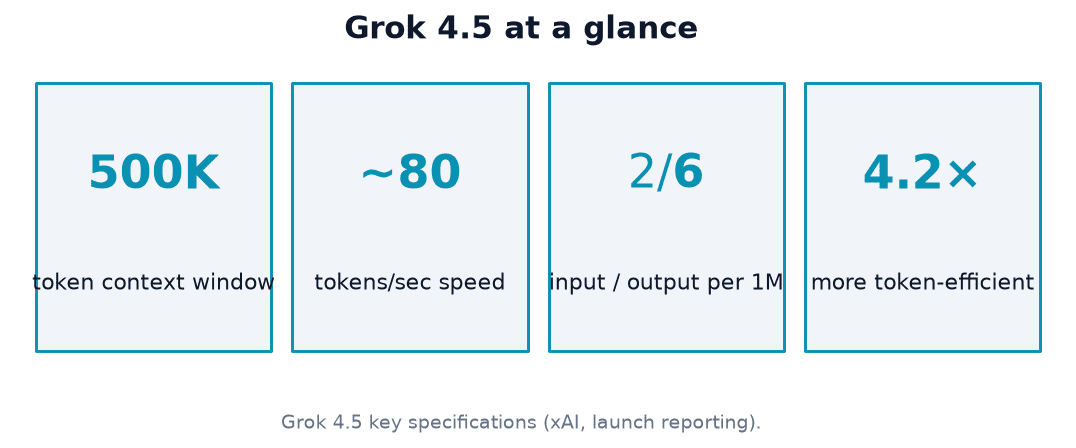
What makes xAI’s frontier model stand out is the combination: roughly 500K tokens of context, built-in real-time search across X and the web, configurable reasoning effort, multimodal input for text and images, and a big jump in token efficiency at $2 input / $6 output per million tokens.
What Is Grok 4.5?
Grok 4.5 is xAI’s newest frontier model, launched July 8, 2026, and positioned as the company’s strongest release yet for coding, agentic tasks, and knowledge work. Elon Musk described it as an “Opus-class model, but faster, more token-efficient and lower cost,” calling it roughly comparable to Opus 4.7 on capability. xAI trained the model in its Memphis data centers using tens of thousands of NVIDIA GB300 GPUs.
A frontier model tuned for real work
Rather than chasing generic benchmark gains, xAI trained Grok 4.5 with reinforcement learning across hundreds of thousands of multi-step software engineering and technical knowledge-work tasks. The training focus was per-token intelligence — squeezing more useful reasoning out of every token generated. The result is a model that reasons more efficiently on real engineering and agentic workloads rather than just scoring well on isolated test questions.
Coding and Agentic Tasks
Grok 4.5 is built to handle serious coding work — from low-level systems programming in Rust and C/C++ to assembling entire applications end-to-end, from a single prompt to a working production build. xAI trained the model to behave like an agent: investigate a problem, call tools, recover from its own mistakes, and verify the results before finishing. It’s the default model in Grok Build, xAI’s coding agent, and it’s also available inside Cursor.
Multi-step, tool-using agents
In agentic mode, Grok 4.5 works through long, multi-step tasks that require creative tool use — spanning software engineering, data science, financial analysis, and legal research. On xAI’s own DeepSWE benchmark, the model reached a 62.0% pass@1 rate, one signal of how it performs on realistic, multi-turn engineering problems rather than single-shot coding puzzles.
Reasoning and Think Mode
Reasoning depth in Grok 4.5 is configurable through the reasoning_effort parameter, which accepts low, medium, or high — high is the default. This lets developers trade reasoning depth against latency and cost depending on the task. It builds on the “Think” mode that’s been part of the Grok lineup since Grok 3, designed specifically for problems that benefit from slower, more deliberate reasoning rather than a fast first-pass answer.
Large 500K Context Window
Grok 4.5 holds roughly 500K tokens of context, per xAI’s developer documentation — enough room for large codebases, long documents, and extended agent sessions inside a single window. For agent loops that run long, the API supports context compaction to keep sessions manageable, and prompt caching cuts the cost of repeated context: cache hits are billed at roughly $0.50 per million tokens.
- Load your codebase, document set, or agent transcript into the context window.
- Set
reasoning_effortbased on task complexity — low for quick lookups, high for deep multi-step work. - Let Grok 4.5 call built-in tools (web search, X search, code execution) as needed.
- For long-running agent sessions, rely on context compaction to avoid hitting the limit.
- Reuse cached context on follow-up calls to cut per-token cost.
Real-Time X and Web Search
A defining trait of the Grok lineup is direct access to current information. Grok 4.5 ships with built-in web search, X search, code execution, and function calling as native tools, according to xAI’s technical documentation. On top of that, DeepSearch — and its deeper variant, DeeperSearch — scans the web and X, reasons across multiple sources, and compiles detailed summaries. That combination is particularly useful for questions about recent events or fast-moving topics where a static training cutoff would fall short, a capability Wikipedia’s entry on Grok also highlights as a distinguishing feature of the model family.
- Web search: pulls current pages from the open web into the model’s context
- X search: surfaces real-time posts and discussion from X
- Code execution: runs code as part of a reasoning chain, not just generates it
- DeepSearch / DeeperSearch: multi-source research with reasoning across results
Image and Vision Understanding
Grok 4.5 is multimodal on the input side: it accepts both text and images and responds in text. That means you can upload a screenshot, a chart, a scanned document, or a photo and ask the model to explain it, extract data from it, or answer questions about what’s shown. Voice interaction and image generation exist elsewhere in the broader Grok product, but for the 4.5 model itself, the input is text-and-image and the output is text.
Speed and Token Efficiency
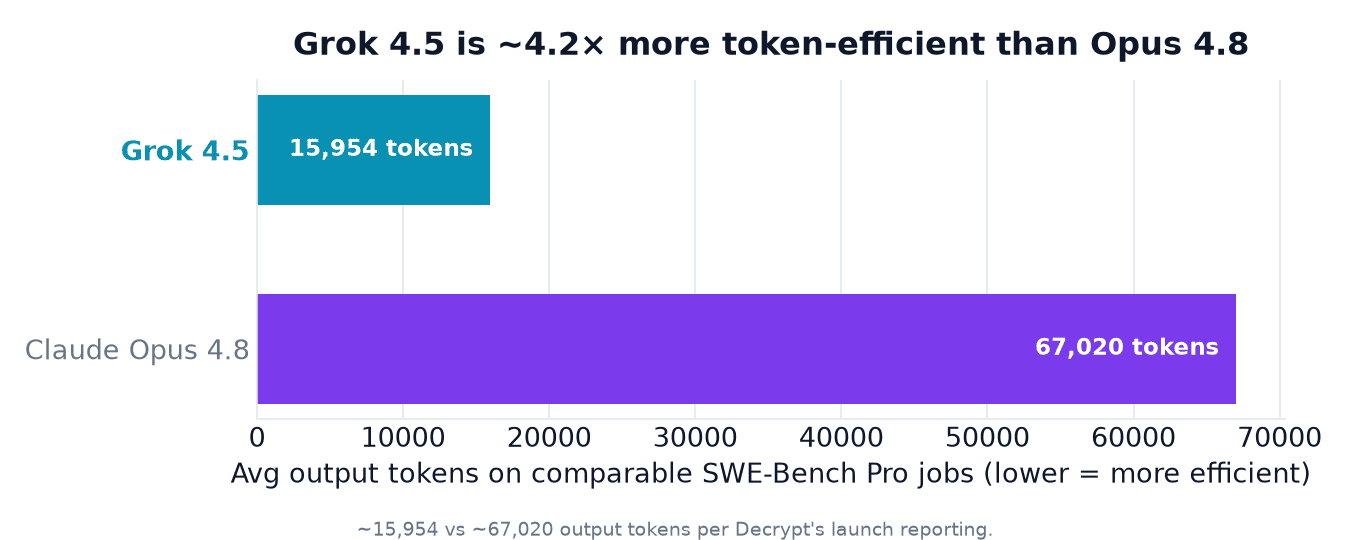
Grok 4.5 runs at fast-model speeds — around 80 tokens per second, with independent measurement from Artificial Analysis putting it near 85.6 tokens per second. Beyond raw speed, xAI reports roughly 2x token efficiency compared with other leading models, meaning Grok 4.5 typically solves tasks in less than half the steps. That combination of speed and efficiency translates directly into lower cost and faster turnaround for the same task.
| Metric | Grok 4.5 |
|---|---|
| Serving speed | ~80 tokens/sec |
| Artificial Analysis measurement | ~85.6 tokens/sec |
| Token efficiency vs. leading models | ~2x |
| Steps to solve typical tasks | Less than half |
Office and Knowledge Work
Outside of code, Grok 4.5 is tuned for office and knowledge work. In Excel, it can build complex financial models that incorporate web research and formulas spanning multiple sheets. In PowerPoint, it assembles diagrams and layouts using native shapes rather than pasted images. In Word, it produces clean, structured prose. Grok 4.5 is the default model across the Microsoft Office add-ins for Word, PowerPoint, and Excel.
- Excel: multi-sheet financial models with live web research folded in
- PowerPoint: native-shape diagrams and slide layouts, not static images
- Word: structured, editable prose output
- Grok Build: default agent for end-to-end coding tasks
- Cursor: available across all plans as a selectable model
As Elon Musk put it when describing the release:
It is an Opus-class model, but faster, more token-efficient and lower cost.
Elon Musk, xAI
That framing — comparable capability, better economics — runs through most of what xAI has published about the model so far.
Pricing and Where to Use Grok 4.5
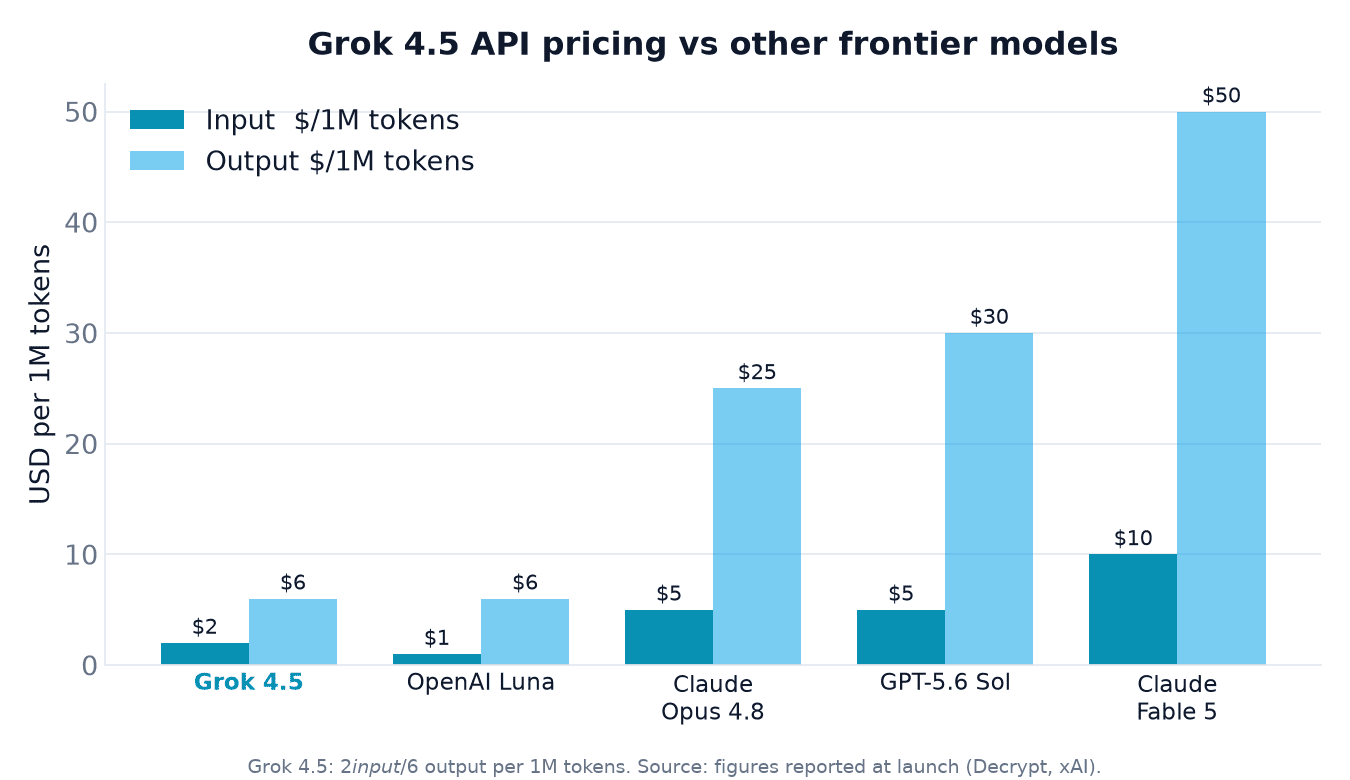
Through the xAI API, Grok 4.5 is priced at $2 per million input tokens and $6 per million output tokens, with cached-context hits billed at roughly $0.50 per million. That undercuts several frontier competitors on paper — Claude Opus 4.7, for comparison, is priced at $5/$25 per million tokens according to reporting from TechCrunch’s coverage of the model landscape.
| Access point | Notes |
|---|---|
| Grok Build | Default model for the coding agent |
| Cursor | Available on all plans |
| Microsoft Office add-ins | Default in Word, PowerPoint, Excel |
| X Premium / SuperGrok | Subscription access |
| xAI API | Pay-per-token, $2/$6 per million |
| OpenRouter, Vercel, Cloudflare, Snowflake, Databricks | Third-party gateways |
At launch, Grok 4.5 is not yet available in the EU, with availability expected around mid-July 2026. Three ways to try it without committing to an API plan:
- Grok Build’s free tier, since Grok 4.5 is the default coding agent model
- Cursor, on any existing plan
- Our free Grok 4.5 chat, for coding, reasoning, and search without setting up API billing