
Explore Grok 4.5: Free chat · Model · Features · API · Pricing · How to use · Use cases · vs GPT-5 · vs Claude
Grok 4.5 Pricing (2026): Free Tiers, SuperGrok Plans, and API Costs Explained
Grok 4.5 is xAI’s latest frontier model, and you can chat with Grok 4.5 free right here before spending a cent — but if you want higher limits or API access, prices range from $0 to around $300 a month. According to xAI’s own announcement, the model was built to push reasoning and coding performance while staying accessible through several pricing tiers.
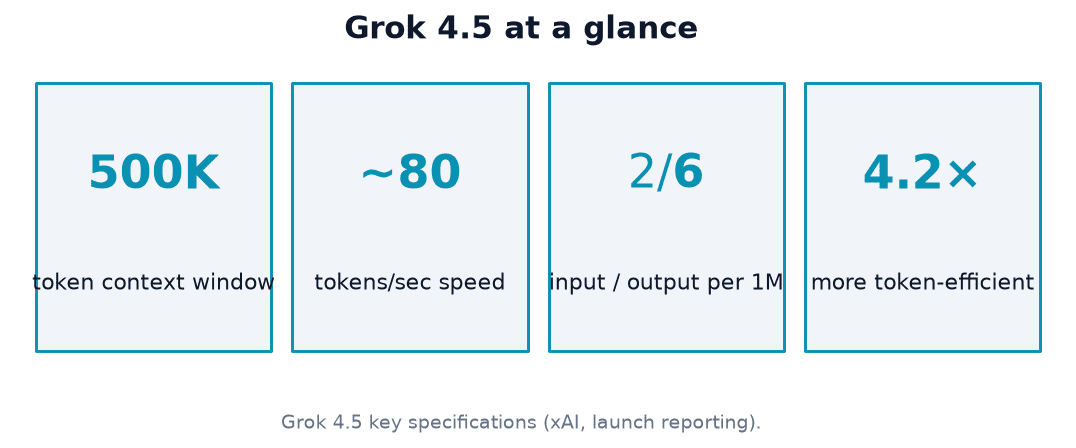
Short answer: Grok 4.5 is free to use with limits on the X app and grok.com, SuperGrok runs around $30/month, and the API is billed at around $2 per million input tokens and $6 per million output tokens. Below, each option in detail, plus how it stacks up against Claude Opus 4.8 and GPT-5.6.
Is Grok 4.5 Free? The Free Tiers
Grok 4.5 is genuinely free to try in more than one place, though each free option comes with its own cap. The differences matter if you’re deciding where to start.
The free chat on this site
Grok-ai.pro offers a free Grok 4.5 chat with no login and no message cap of the usual kind — a zero-cost way to try the model before committing to any paid plan. It’s an independent reference site for trying Grok 4.5, not xAI’s official product.
X app and grok.com free access
Inside the X (formerly Twitter) app, free users get roughly 10 Grok messages per rolling 2-hour window for text chat. The window starts on your first prompt and refreshes about two hours later — it isn’t a fixed daily quota, and xAI adjusts the caps with demand without publishing exact numbers.
grok.com mirrors this free-tier approach: no credit card is required to start chatting with Grok. Since March 2026, image and video generation moved behind paid plans, so the free tier on both grok.com and the X app is now text-only.
The free options break down like this:
- grok-ai.pro — free chat, no login, no usual message cap
- X app — roughly 10 text messages per rolling 2-hour window
- grok.com — no credit card required, text-only since image/video went paid
- Images and video — no longer part of any free tier as of March 2026
SuperGrok and X Subscription Tiers
Paid tiers exist mainly to raise the rate limits and unlock features the free tier holds back, like deeper research tools and voice mode.
Higher limits and extra features. Paid tiers raise the message rate limits well above the free rolling window and unlock DeepSearch, Big Brain reasoning mode, and voice mode — the parts of Grok that free users only get in a stripped-down form.
Four tiers at different price points. SuperGrok Lite sits at the entry level for around $10/month, aimed at people who just want more messages than the free cap allows. SuperGrok itself, the mid-tier plan most people compare against ChatGPT Plus or Claude Pro, runs around $30/month or $300/year. X Premium+ bundles Grok access with X platform perks (fewer ads, longer posts, checkmark) for around $40/month. SuperGrok Heavy sits at the top for around $300/month, adding the highest limits plus a multi-agent “Heavy” mode for complex tasks.
| Plan | Approx. price | What it adds |
|---|---|---|
| SuperGrok Lite | ~$10/month | Higher free-tier limits |
| SuperGrok | ~$30/month or ~$300/year | DeepSearch, Big Brain, voice mode |
| X Premium+ | ~$40/month | Grok access bundled with X platform perks |
| SuperGrok Heavy | ~$300/month | Highest limits, multi-agent Heavy mode |
Paid plans generally unlock:
- Higher message rate limits than the free rolling window
- DeepSearch for deeper research queries
- Big Brain reasoning mode for harder problems
- Voice mode for spoken conversations
All of these numbers are approximate and change fairly often — check the official plans page before subscribing.
Grok 4.5 API Pricing (Per Token)
Developers building on Grok 4.5 pay per token rather than a flat monthly fee, and the rate structure has a few wrinkles worth knowing before you estimate a project’s cost.
The core rates
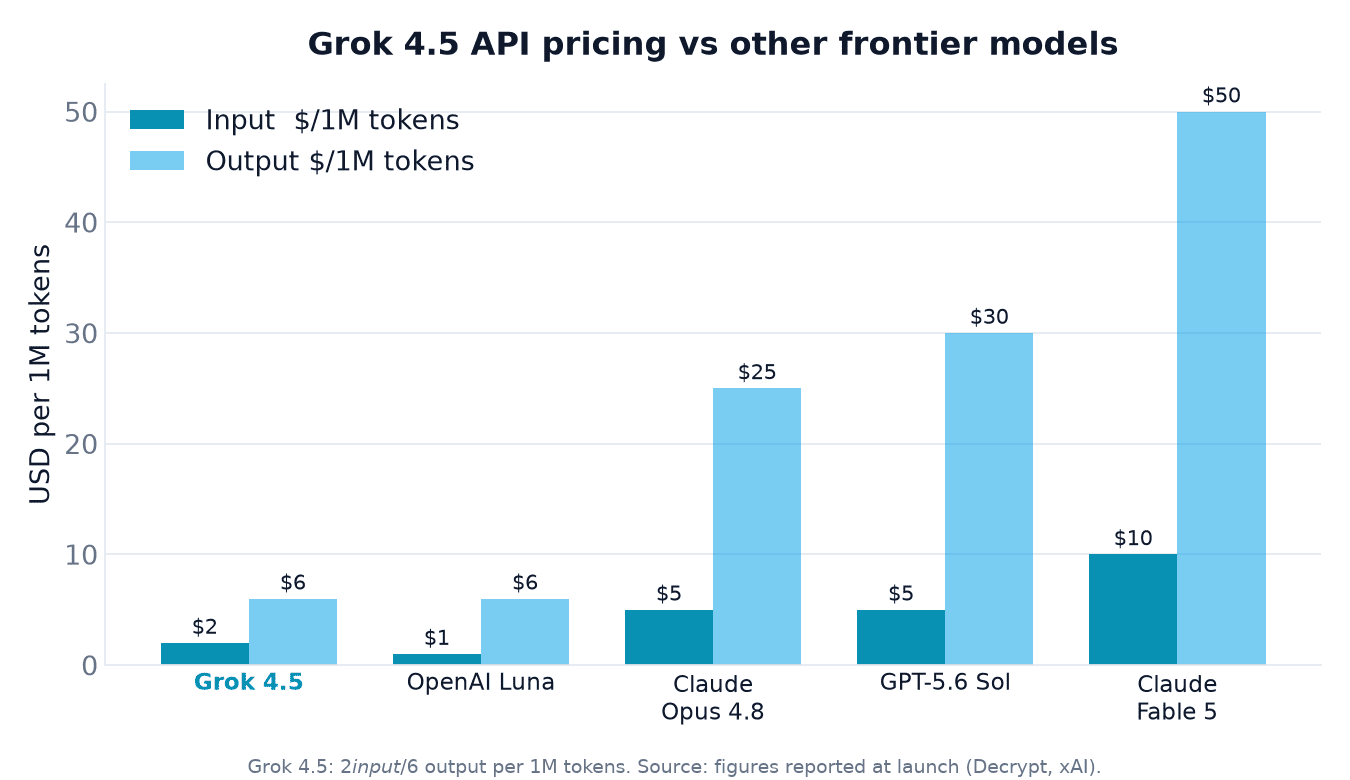
The xAI API pricing page lists Grok 4.5 at around $2 per million input tokens and around $6 per million output tokens, with cached input around $0.50 per million. Output is the priciest component of any bill, so it’s worth planning prompts and response lengths around it rather than around input volume alone. Third-party aggregators like OpenRouter list comparable per-token rates for reference.
| Token type | Approx. cost per 1M tokens |
|---|---|
| Input | ~$2.00 |
| Cached input | ~$0.50 |
| Output | ~$6.00 |
Context window and the 200K higher tier
Grok 4.5 exposes a context window of around 500,000 tokens — enough to hold large codebases or long documents in a single request. A higher pricing tier applies once a request exceeds 200K tokens, so very long-context runs cost more per token than short ones. The model runs at roughly 80 tokens per second and supports tool calling for agentic workflows.
Getting started with the API
- Create an xAI account and generate an API key from the developer console.
- Point your existing OpenAI or Anthropic SDK client at the xAI base URL — the API is compatible with both.
- Send a test request with a short prompt to confirm authentication works.
- Check the response for token usage counts to sanity-check billing.
- Enable prompt caching for any system prompt or document you’ll reuse across calls.
- Set a max-output-token cap to control the most expensive part of the bill.
- Monitor usage in the dashboard before scaling up request volume.
Because the API mirrors familiar SDK patterns, migrating an existing OpenAI or Anthropic integration to Grok 4.5 is mostly a matter of generating a key and changing the base URL.
How Grok 4.5 Compares to Claude Opus 4.8 and GPT-5.6
Price alone doesn’t tell the whole story, but it’s the first filter most teams apply when picking a model for a high-volume task.
Side-by-side per-million-token costs
| Model | Input (per 1M) | Output (per 1M) |
|---|---|---|
| Grok 4.5 | ~$2 | ~$6 |
| Claude Opus 4.8 | ~$5 | ~$25 |
| GPT-5.6 | ~$5 | ~$30 |
On list price, Grok 4.5’s output rate is roughly a quarter of Claude Opus 4.8’s and a fifth of GPT-5.6’s. That dynamic is visible across all three vendors — each has cut per-token prices repeatedly since their first frontier releases, and Grok 4.5’s rates reflect the same downward trend.
What the price gap does and does not mean
Cheaper tokens do not automatically mean better outputs for every task. Price is one axis; benchmark quality, reasoning depth, and tool-use reliability are separate axes that vary by workload. A team running millions of simple classification calls benefits enormously from Grok 4.5’s lower output cost, while a team needing the highest possible reasoning accuracy on a handful of hard problems might weigh quality more than price.
Where price mostly matters:
- High-volume, simple tasks like classification or summarization
- Long-running agent loops with many tool calls
- Prototyping where iteration speed matters more than peak accuracy
- Budget-constrained projects scaling to millions of requests
Comparing raw per-token numbers is a starting point, not the final answer. xAI’s own framing leans on that cost angle rather than raw benchmarks — when Elon Musk announced the public launch, he described the model this way:
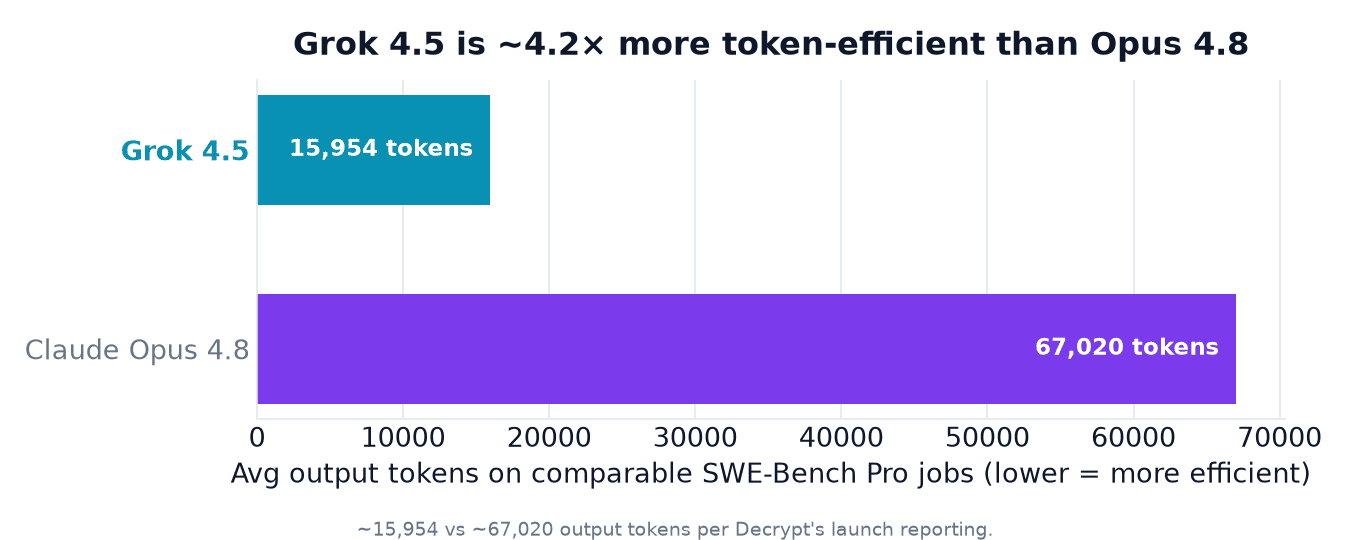
It is an Opus-class model, but faster, more token-efficient and lower cost.
Elon Musk
How to Spend Less on Grok 4.5
A few habits meaningfully lower a Grok 4.5 API bill without changing what you’re building.
Cache repeated context
Prompt caching bills repeated context — system prompts, long reference documents, few-shot examples — at around $0.50 per million tokens instead of the standard $2 per million, roughly 60-80% cheaper on the repeated portion. Reusing cached prefixes across calls is the single biggest lever for teams sending similar context on every request.
Trim input and cap output
Output tokens at around $6 per million are the biggest cost driver on most bills, so capping max output tokens and asking for concise answers pays off quickly. Trimming boilerplate from prompts cuts input-token cost too. Staying under 200K tokens per request when possible also avoids the higher long-context pricing tier described earlier.
Quick checklist for lowering a Grok 4.5 bill:
- Cache repeated system prompts and reference documents
- Cap max output tokens per request
- Trim boilerplate and redundant instructions from prompts
- Keep requests under 200K tokens when the task allows it