
Explore Grok 4.5: Free chat · Model · Features · API · Pricing · How to use · Use cases · vs GPT-5 · vs Claude
Grok 4.5 vs Claude: Benchmarks, Pricing, and Which One to Use in 2026
Grok 4.5 from xAI is pitched as an “Opus-class” model that trades a little raw benchmark score for a much cheaper token bill, while Anthropic’s Claude — Opus 4.8 and Fable 5 — still tops most leaderboards. If you want to try xAI’s model first, our Grok 4.5 free chat lets you test it before comparing token costs with Claude.
Bottom line: pick Claude when you want the strongest coding and reasoning scores; pick Grok 4.5 when cost per token and speed matter more than the last few benchmark points.
Who Builds Each Model: xAI vs Anthropic
Two different labs sit behind these names, and the branding sometimes causes confusion. Grok 4.5 is developed and shipped by xAI, while the Claude family — including Claude Opus 4.8 and Claude Fable 5 — comes from Anthropic. Elon Musk framed Grok 4.5 as “an Opus-class model, but faster, more token-efficient and lower cost,” directly naming Anthropic’s premium tier as the comparison point.
Grok 4.5 is an xAI model
xAI develops and ships Grok 4.5. It is positioned by xAI as an Opus-class model — comparable in capability to Anthropic’s top-tier Opus family, but built to run faster and cheaper per token. In short, Grok 4.5 is the latest model in xAI’s Grok line, and it is xAI you are comparing against Anthropic here.
Claude is built by Anthropic
Anthropic builds the Claude family, and the current flagships are Claude Opus 4.8, the widely used top-tier model for coding and reasoning, and Claude Fable 5, Anthropic’s most capable widely released model. Anthropic’s own pricing page is the authoritative source for how the company positions and prices the Claude lineup.
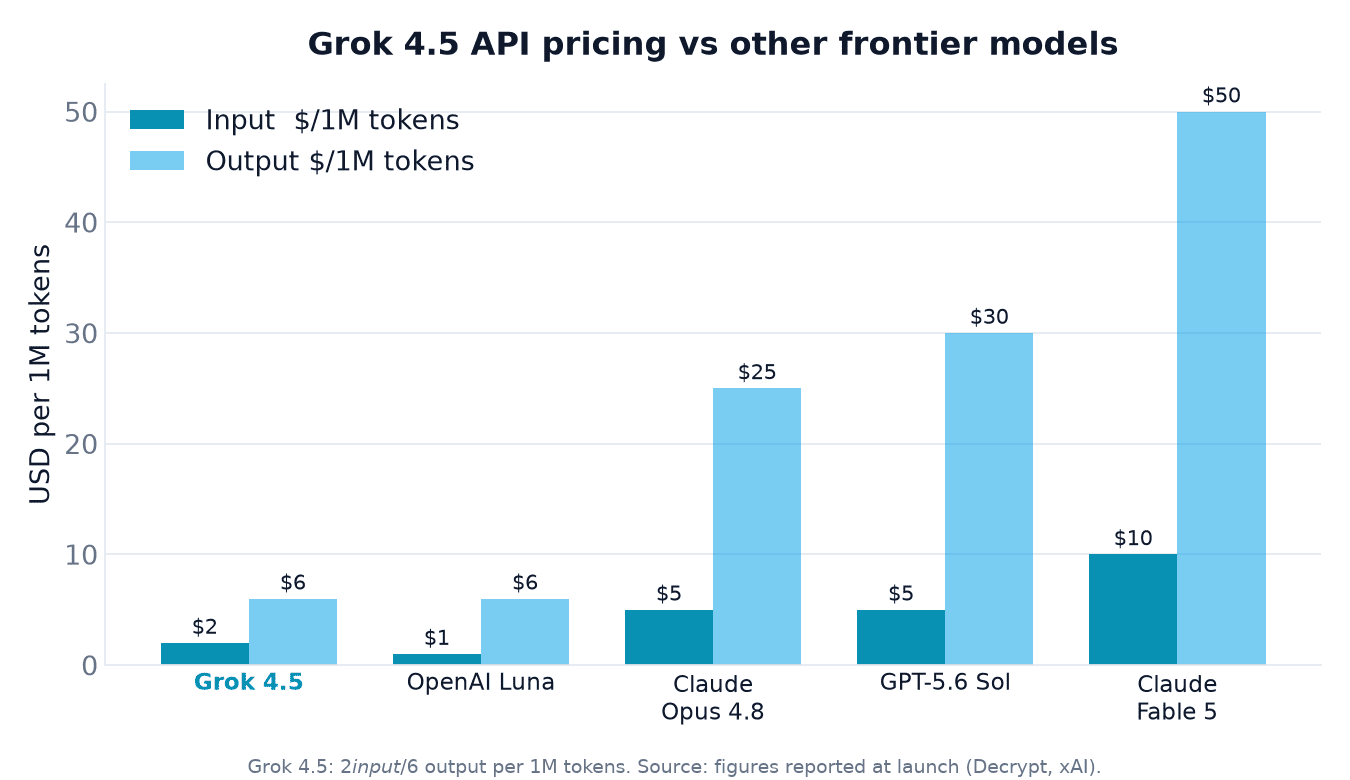
Pricing: Grok 4.5 vs Claude (per 1M tokens)
Token pricing is where the two approaches diverge most sharply, and it’s usually the first number teams check before running a head-to-head test.
| Model | Input ($/1M tokens) | Output ($/1M tokens) |
|---|---|---|
| Grok 4.5 | $2 | $6 |
| Claude Opus 4.8 | $5 | $25 |
| Claude Fable 5 | $10 | $50 |
Side-by-side price table
Grok 4.5 runs roughly 2.5x cheaper than Opus 4.8 on input tokens and about 4x cheaper on output tokens. Against Claude Fable 5, the gap widens further — Fable 5 charges 5x Grok’s input rate and more than 8x its output rate. xAI, the company behind Grok, is documented on Wikipedia as a separate entity from Anthropic, and the pricing gap holds regardless of which Claude tier a team compares against.
What the price gap means in practice
For high-volume workloads — agents running long tool loops, batch summarization, or retrieval-augmented generation over large document sets — the per-token gap compounds fast. A workload that costs $100 a day on Opus 4.8 output tokens would run roughly $24 a day on Grok 4.5 output tokens at the same token count. That arithmetic is the headline reason some teams default to Grok 4.5 for high-throughput jobs, even when Claude scores slightly higher on quality benchmarks.
Workloads where the price gap tends to matter most:
- Long-running coding agents that loop through many tool calls per task
- Batch summarization of large document sets
- Retrieval-augmented generation over large knowledge bases
- Customer-support automation handling high daily conversation volume
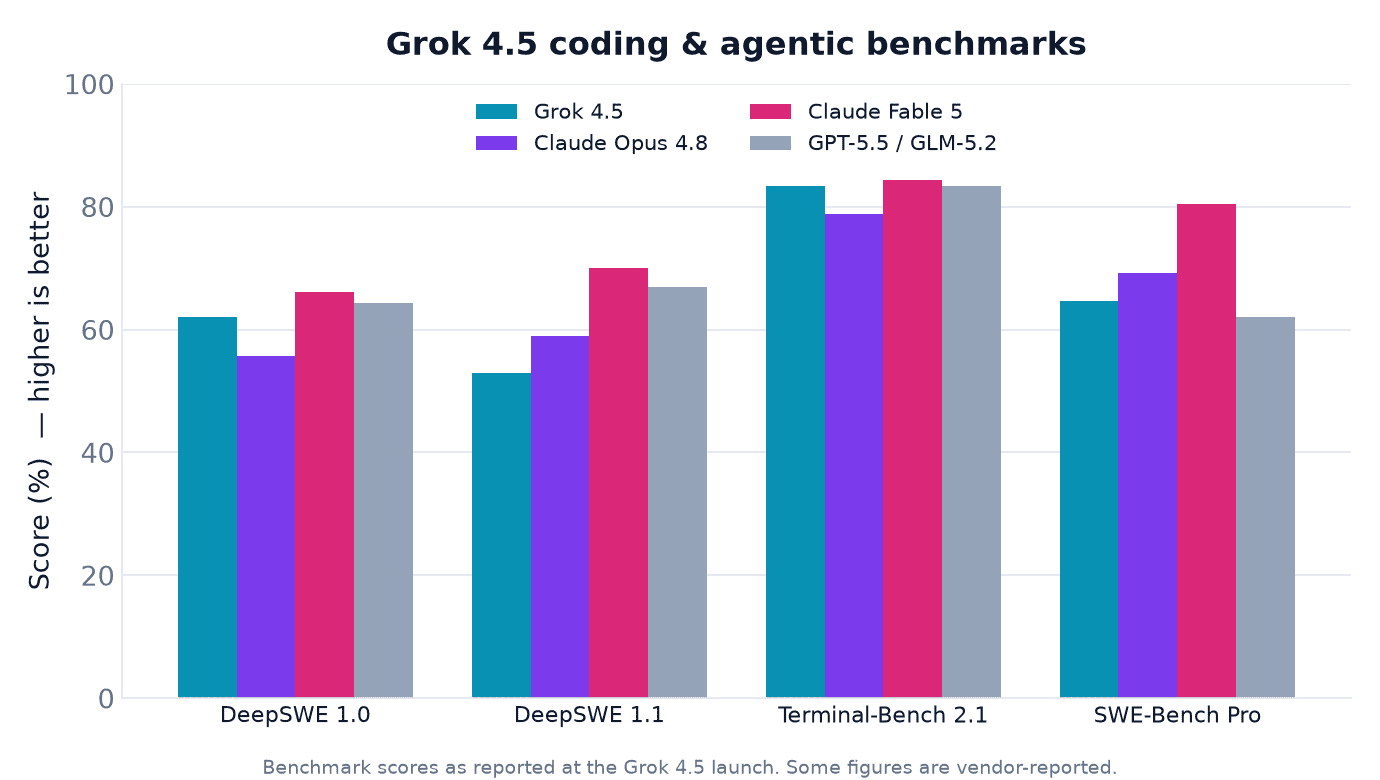
Benchmarks: Coding, Agentic, and Reasoning
Raw scores tell a more one-sided story than pricing does, at least on coding-focused test suites.
Claude leads on coding benchmarks. On composite coding suites such as SWE-bench Pro, Claude Fable 5 is reported in the mid-80s while Grok 4.5 lands in the mid-60s; Opus 4.8 also leads Grok 4.5 on SWE-bench-style coding tasks. Treat these as figures reported by comparison leaderboards rather than fixed constants — exact scores shift by suite version and test date.
Agentic and reasoning work narrows the gap. On agentic tool-use benchmarks the two models sit much closer together, with Fable 5 reported around the mid-80s against Grok 4.5 in the low-to-mid 80s. Grok 4.5 uses explicit chain-of-thought reasoning before acting, which helps it stay competitive on multi-step agent tasks even where it trails on pure coding scores. The pattern repeats across benchmark categories: Grok trades a few points of raw score for a large price cut, staying close rather than winning outright.
| Benchmark category | Claude (Opus 4.8 / Fable 5) | Grok 4.5 |
|---|---|---|
| Coding (composite suites) | Leads — Fable 5 reported mid-80s | Trails — reported mid-60s |
| Agentic tool-use | Leads narrowly — Fable 5 reported mid-80s | Close behind — reported low-to-mid 80s |
Benchmark leaderboards are provisional and shift as vendors refresh scores and suites get updated. The stable takeaway isn’t any single decimal — it’s that Claude leads on raw scores while Grok 4.5 stays close for a fraction of the cost.
An Opus-class model, but faster, more token-efficient and lower cost.
Elon Musk, xAI
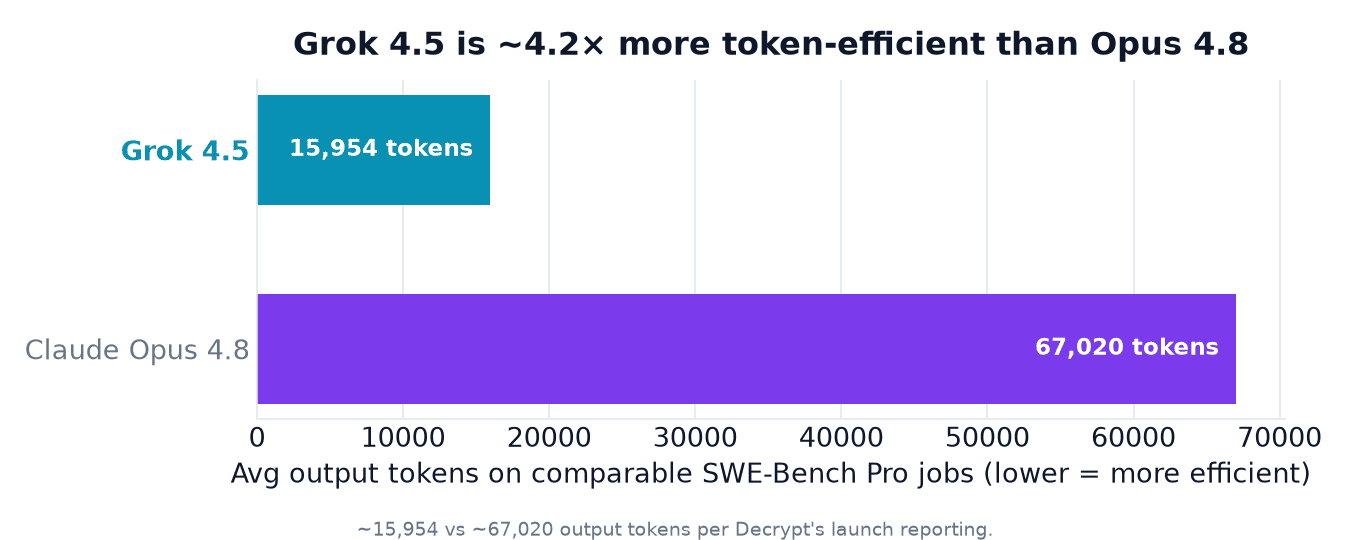
Token Efficiency and Effective Cost
Sticker price per token isn’t the whole picture, and this is where a lot of budget estimates go wrong.
Effective cost is the price per token multiplied by the number of tokens a model actually consumes to finish a task. A model with a higher listed price but tighter, more efficient output can end up cheaper in practice than a lower-priced model that pads its responses. xAI markets Grok 4.5 as notably more token-efficient than prior Grok generations, though the exact efficiency multiplier for any specific workload should be verified against your own logs rather than assumed from marketing copy.
The cost advantage is clearest on output-heavy, high-volume workloads, where the $6 versus $25 output gap between Grok 4.5 and Opus 4.8 dominates the monthly bill. For short prompts or low-volume use, both models are cheap enough in absolute terms that output quality — not price — should be the deciding factor.
Context Window and Limits
Context window comparison
Claude’s current flagships, Opus 4.8 and Fable 5, offer a 1M-token context window. Grok 4.5 offers a 500K-token window — half that size. For very large codebases, long legal documents, or multi-file analysis that spans hundreds of thousands of tokens, Claude’s larger window is a genuine advantage. For typical chats, mid-size documents, and most day-to-day agent runs, a 500K window is ample and rarely the limiting factor.
How to check if the window size matters for you
- Estimate the token count of your largest single input (a full codebase, a long transcript, a document set).
- Convert rough word or character counts to tokens — as a starting point, assume roughly 4 characters per token in English text.
- Compare that figure against 500K (Grok 4.5) and 1M (Claude Opus 4.8 / Fable 5).
- If your largest input regularly exceeds 500K tokens, favor Claude for that workload.
- If your inputs stay comfortably under 500K, context size stops being a deciding factor — move to price and benchmark scores instead.
Which One Should You Choose?
The decision usually comes down to whether raw quality or cost efficiency matters more for a given workload, and the two models suit genuinely different priorities rather than one simply beating the other.
Choose Claude when…
You need the best raw coding and reasoning scores, the largest context window at 1M tokens, or the strongest agentic long-horizon performance. Opus 4.8 is the balanced top-tier pick; Fable 5 is for the most demanding tasks where quality outweighs cost. Claude’s higher token price is worth paying when output quality is the priority, not the budget. In short, reach for Claude when:
- Coding accuracy on hard problems is the top priority
- Your inputs regularly exceed 500K tokens
- You’re running long, complex agentic workflows where mistakes are costly
- Budget is secondary to output quality
Choose Grok 4.5 when…
Cost per token and speed matter most, workloads run at high volume, and “Opus-class, close enough” quality is acceptable for the task. Grok 4.5 is the budget pick that stays competitive on agentic work while costing a fraction of Claude’s output price. Try it in our Grok 4.5 free chat before committing a production workload to either model. Reach for Grok 4.5 when:
- Token volume is high and cost per request needs to stay low
- Your context needs fit comfortably under 500K tokens
- Agentic task quality close to Opus-class is good enough
- Speed matters as much as raw benchmark score