
Explore Grok 4.5: Free chat · Model · Features · API · Pricing · How to use · Use cases · vs GPT-5 · vs Claude
Grok 4.5 vs GPT-5: Which AI Model Should You Actually Use in 2026?
Grok 4.5 (from xAI) and GPT-5 (from OpenAI) are the two models most people weigh against each other right now — you can try free Grok 4.5 chat online before you commit to either. According to benchmark data published by OpenAI and xAI, the short answer is this: Grok 4.5 wins on price and real-time data, GPT-5 still edges out the hardest reasoning and multimodal benchmarks — so the “better” model depends on your job.
This guide compares them head-to-head on pricing, benchmarks, context window, coding, reasoning, and availability, with every number attributed rather than hyped. By the end you’ll know which model fits your workload, and whether it makes sense to run both.
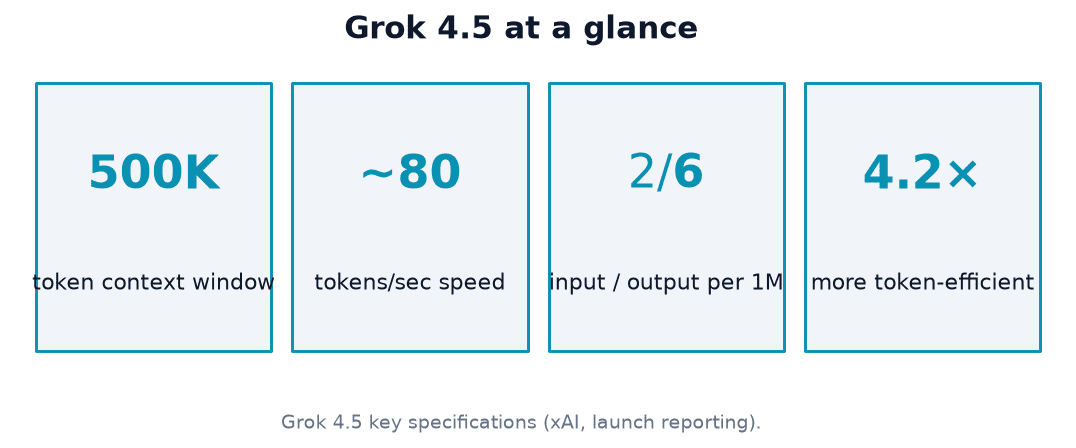
Grok 4.5 vs GPT-5 at a glance
Grok 4.5 is xAI’s model, and GPT-5 is OpenAI’s model — both are proprietary reasoning systems with image input, but they were built with different priorities. GPT-5 launched on August 7, 2025, while the Grok 4 line arrived on July 9, 2025, and xAI’s Grok 4.5 followed as a cost-efficient update to that lineup. The two companies compete directly for the same enterprise and developer audience, which is why xAI’s Grok 4.5 and GPT-5 keep showing up in the same comparison threads.
The one-line summary
Grok 4.5 is xAI’s cost-efficient flagship, built for cheap, high-volume use and live data from X. GPT-5 is OpenAI’s broad, high-ceiling flagship, with the latest line extending into premium reasoning tiers like GPT-5.6 Sol. The honest verdict up front: if your workload is price-sensitive or needs live web/X data, Grok 4.5 usually wins; if you need the most-verified reasoning ceiling and the broadest third-party ecosystem, GPT-5 usually wins. The sections below back that up with numbers.
Quick comparison table
| Factor | Grok 4.5 (xAI) | GPT-5 (OpenAI) |
|---|---|---|
| Maker | xAI | OpenAI |
| Positioning | Cost efficiency + real-time data | Broad reasoning + multimodal |
| Context window | ~500K tokens via API (earlier Grok 4 was 256K via API) | 400K tokens, up to 128K output |
| Input price | ~$2 / 1M tokens | ~$1.25 / 1M tokens (standard tier) |
| Output price | ~$6 / 1M tokens | ~$10 / 1M tokens (standard tier) |
| Real-time data | Native, via X | Via ChatGPT’s browsing tool |
| Where to use | X, grok.com, xAI API | ChatGPT, OpenAI API |
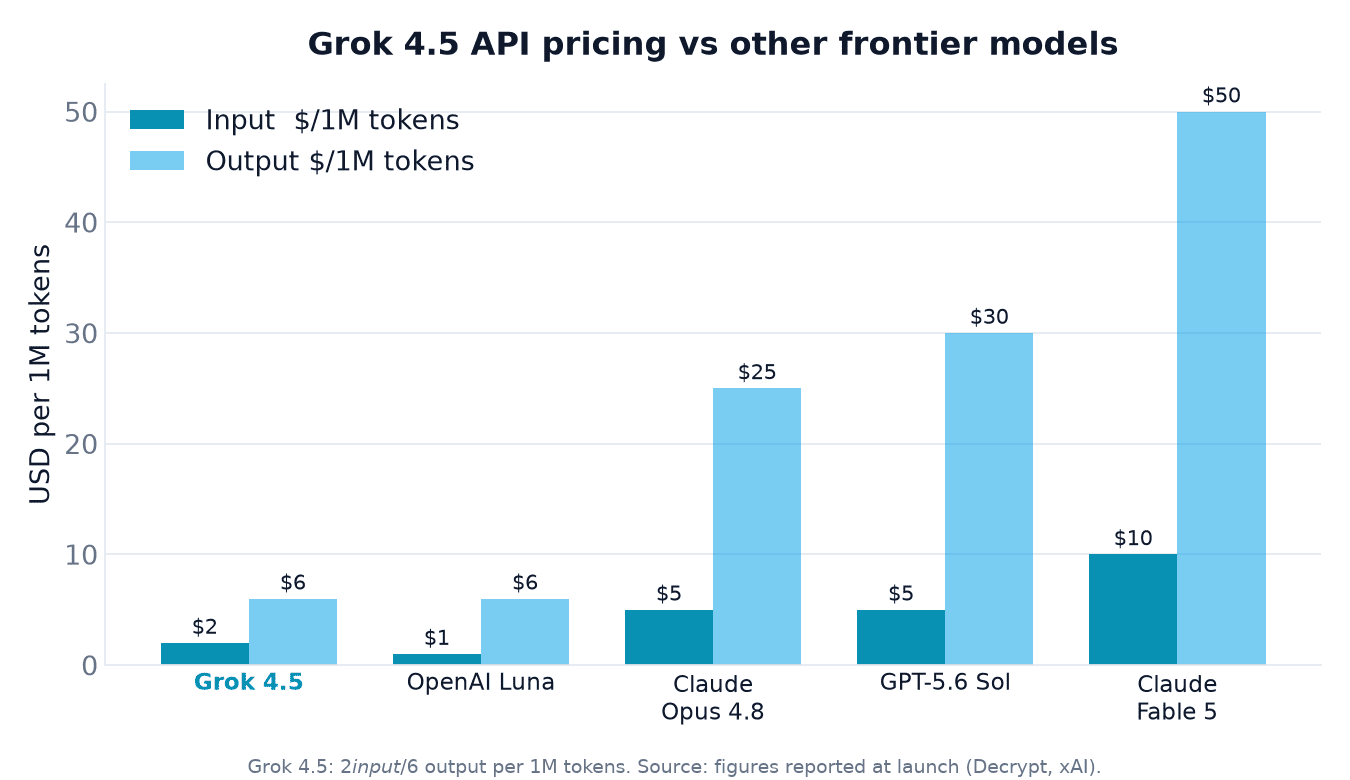
Pricing: Grok 4.5 is the cheaper model
Token pricing is where the gap between xAI and OpenAI is clearest. Grok 4.5 runs at roughly $2 per 1 million input tokens and $6 per 1 million output tokens. GPT-5’s standard API tier is priced at about $1.25 per 1 million input tokens and $10 per 1 million output tokens, though OpenAI’s premium reasoning tiers (GPT-5.5 and GPT-5.6 Sol) cost meaningfully more, on the order of $5 input / $30 output per 1 million tokens. For reference, the previous-generation Grok 4 was priced at $3 / $15, so Grok 4.5 represents a real price cut from xAI. Check OpenAI’s official pricing page for the current standard and premium tiers before budgeting a project.
Per-token cost
On a straight per-token basis, Grok 4.5 costs more to send input (around $2 vs GPT-5’s $1.25) but noticeably less to receive output (around $6 vs GPT-5’s $10). That split matters depending on your workload:
- Chat-heavy applications that generate lots of short replies benefit from Grok 4.5’s lower output price.
- Read-heavy applications that ingest huge documents benefit from GPT-5’s lower input price.
- Mixed workloads with both long prompts and long replies need a blended estimate rather than either single number.
These figures move as vendors update pricing, so treat them as directional rather than fixed.
Real cost = tokens x efficiency
Cheaper per token isn’t the whole story. xAI positions Grok 4.5 as token-efficient, meaning it can complete the same task using fewer output tokens than a less efficient model — which can widen the real-world cost gap beyond what the sticker price suggests. GPT-5’s lower input price, on the other hand, helps long-context, read-heavy tasks like summarizing large codebases or document sets. Both claims come from the vendors themselves, so real-world testing on your own workload is the only way to confirm which model actually costs less for you.
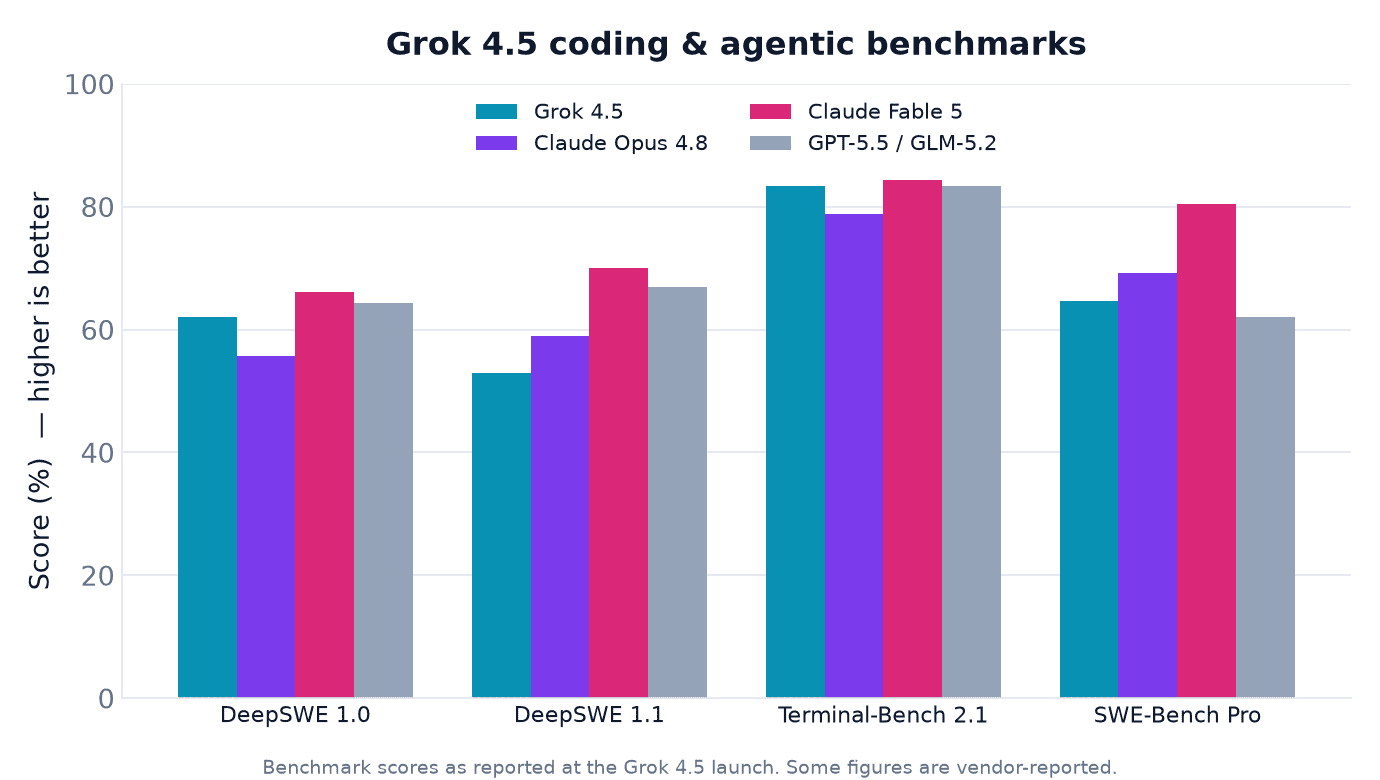
Benchmarks: how close is the performance?
Benchmark numbers for Grok 4.5 and GPT-5 come from different test suites published by each vendor, which makes direct comparison tricky. GPT-5 posts a SWE-bench Verified score of 74.9%, an Aider Polyglot score of 88%, an AIME 2025 score of 94.6%, and a GPQA Diamond score of 85.7%, according to OpenAI. xAI’s Grok 4 — the line Grok 4.5 extends — reports 44.4% on Humanity’s Last Exam and 61.9% on USAMO 2025 in its multi-agent “Heavy” configuration (lower without that setting), plus 15.9% on ARC-AGI-2, according to x.ai; xAI hasn’t published separate Grok-4.5-specific scores for these three tests. Grok 4.5’s own published number is 83.3% on Terminal-Bench 2.1. On the third-party Artificial Analysis Intelligence Index, the two models land very close together, with GPT-5 (high) slightly ahead.
| Benchmark | GPT-5 | Grok |
|---|---|---|
| SWE-bench Verified | 74.9% | Not directly published; competitive on Terminal-Bench 2.1 (83.3%) |
| Aider Polyglot | 88% | Not directly published |
| AIME 2025 | 94.6% | Not directly published |
| GPQA Diamond | 85.7% | Not directly published |
| Humanity’s Last Exam (Heavy config, with tools) | Not directly published | 44.4% |
| USAMO 2025 (Heavy config) | Not directly published | 61.9% |
| ARC-AGI-2 | Not directly published | 15.9% |
Coding
GPT-5 has the more complete set of published, independently verifiable coding numbers: a SWE-bench Verified score of 74.9% and an Aider Polyglot score of 88% with reasoning enabled, both reported by OpenAI. Grok 4.5 is competitive on agentic coding and terminal-based tasks, landing in the low-80s percent range on Terminal-Bench 2.1. In practice, the two models sit in the same performance tier for coding work — GPT-5 simply has more third-party-verifiable coding evals to point to.
Reasoning & math
GPT-5 leads on the published math and PhD-level reasoning evals. It scores 94.6% on AIME 2025 and 85.7% on GPQA Diamond, both figures OpenAI reports directly. Grok’s math result comes from USAMO 2025, where its Heavy configuration scores 61.9%, and from Humanity’s Last Exam, where the same multi-agent setup scores 44.4% — but these tests use different tool and reasoning settings than GPT-5’s evals, so a raw number-to-number comparison overstates the gap. On the aggregate Artificial Analysis Intelligence Index, which normalizes across a broader set of tasks, the difference between the two shrinks to a small edge for GPT-5 (high).
The apples-to-oranges caveat
Vendors publish self-selected benchmarks, often run with different tool access and reasoning-effort settings, so treating any single number as a precise, universal ranking is a mistake. A model tested “with tools” on one benchmark and “without tools” on another isn’t being measured the same way twice. For a fairer read, independent aggregators like Artificial Analysis normalize scoring conditions across models — worth checking before you make a decision based on any single published benchmark.
Context window and long documents
GPT-5 offers a 400K-token context window, roughly 600 pages of text, with up to 128K tokens of output. Grok 4.5’s API context window sits at roughly 500K tokens, an increase over the previous Grok 4’s 256K-token API limit. That’s a meaningful jump generation over generation on xAI’s side, though context limits are one of the numbers most likely to change between model updates. If your project depends on Grok 4.5’s exact current context limit, verify it directly against xAI’s API documentation before committing to an architecture around it.
How much text each can hold
A 400K-token window, like GPT-5’s, comfortably covers most single codebases, long meeting transcripts, or a stack of PDFs in one pass. Grok 4.5’s roughly 500K-token API window goes a step further, useful for larger document sets or bigger multi-file projects, but both figures move as vendors ship updates — treat them as a snapshot, not a permanent ceiling.
Real-time data and web access
Grok’s clearest structural advantage over GPT-5 is its native tie-in to X, which gives it real-time access to posts and web content as part of the base model rather than as an add-on tool. GPT-5 reaches current information through a separate browsing tool inside ChatGPT, not baked into the base model itself. The two also differ on training data recency: GPT-5’s knowledge cutoff sits around September 2024, while Grok 4’s published cutoff is roughly November 2024 (xAI hasn’t disclosed an updated cutoff specifically for Grok 4.5) — a modest head start on more recent events even before live data is factored in.
xAI has repeatedly described Grok’s guiding design principle as being “maximally truth-seeking,” saying the model is built to prioritize evidence and reasoning over political correctness or corporate caution — even when that means giving answers some people find politically incorrect. That’s a paraphrase of xAI’s stated philosophy rather than a single verbatim quote; see x.ai for the company’s current framing.
Grok’s edge: live X and web
Grok’s native connection to X gives it a real, structural advantage for “what’s happening right now” queries — trending topics, breaking news, and current public sentiment. This is Grok’s single clearest differentiator against GPT-5, and it’s the reason people reach for Grok specifically when the question is time-sensitive rather than purely analytical.
GPT-5’s browsing model
GPT-5 gets fresh information through ChatGPT’s dedicated web-browsing tool rather than a built-in live feed. That’s a fine setup for research tasks where you want the model to search, read, and synthesize sources, but it’s a step slower than Grok’s always-on connection to X for genuinely live information. The later knowledge cutoff on Grok’s side compounds this advantage for anything that happened in the months between the two models’ training cutoffs.
Where each approach tends to fit best:
- Breaking news, trending topics, live sentiment — Grok’s native X integration.
- Deep-dive research across multiple sources — GPT-5’s browsing tool, given time to search and read.
- Anything after September 2024 but before a browsing session — Grok’s later training cutoff has an edge by default.
Availability: where you actually use each
Here’s how to actually get access to each model, step by step:
- For Grok 4.5: open an X Premium subscription, or go to grok.com directly, or integrate the xAI API into your own product.
- For a quick, no-account preview of Grok 4.5-style chat: try a free front-end like grok-ai.pro.
- For GPT-5: sign up for ChatGPT on any tier from Free through Enterprise, or integrate the OpenAI API directly.
- If you need enterprise-grade integrations: check OpenAI’s Enterprise plan and xAI’s API documentation for SLAs and data-handling terms before committing either model to production.
- If cost is the deciding factor: start with the API pricing pages for both xAI and OpenAI and run a small pilot on your actual workload before scaling up.
Grok 4.5 access
Grok 4.5 is available through X (on the Premium tier), through grok.com directly, and through the xAI API for developers building their own products. For anyone who wants to try Grok-style chat without creating an account first, unofficial front-ends like grok-ai.pro offer a free way to test it — worth noting that such sites are unofficial reference and chat front-ends, not xAI’s own product.
GPT-5 access
GPT-5 is available across every ChatGPT tier, from Free through Plus, Pro, and Enterprise, as well as through the OpenAI API for developers. This gives GPT-5 the broadest existing ecosystem and the deepest bench of third-party integrations of the two models, which matters if you’re plugging an AI model into tools that already have OpenAI support built in.
Which should you pick?
- Cost-sensitive, high-volume workloads — Grok 4.5’s lower output pricing adds up fast at scale.
- Anything needing live X or web data — Grok 4.5’s native real-time integration is hard to replicate with a browsing tool.
- Agentic and coding tasks where token efficiency matters — Grok 4.5’s efficiency claims can lower real-world cost even where per-token pricing looks close.
- The broadest, most-verified benchmark ceiling — GPT-5 has more published, independently checkable numbers across coding, math, and reasoning.
- Deep multimodal and enterprise integrations — GPT-5’s ecosystem and long-context read workloads (up to 400K verified tokens) are the safer bet.
Pick Grok 4.5 if…
You’re running cost-sensitive, high-volume workloads, you need real-time X or web data baked into the model itself, your tasks are agentic or coding-heavy and benefit from token efficiency, or you simply want the cheapest model in this performance tier without a major quality trade-off.
Pick GPT-5 if…
You want the broadest, most independently verified benchmark ceiling, strong multimodal handling, a deep third-party integration ecosystem, or you’re running the largest long-context read workloads where GPT-5’s verified 400K-token window is the safer, better-documented option. Enterprise teams with existing OpenAI integrations will also find GPT-5 the lower-friction choice.
Can you use both?
Yes — many teams route cheap, real-time tasks to Grok 4.5 and reserve the hardest reasoning or multimodal work for GPT-5, treating the two as complementary rather than exclusive. If you’re undecided, start by trying Grok 4.5 through a free chat interface, then compare its output directly against GPT-5 on your own real tasks before picking a primary model.