
Explore Grok 4.5: Free chat · Model · Features · API · Pricing · How to use · Use cases · vs GPT-5 · vs Claude
Grok 4.5 Model Explained: Architecture, Benchmarks, Pricing and What’s New
Grok 4.5 is xAI’s flagship large language model, released on July 8, 2026, built for coding, agentic tasks and knowledge work. According to xAI’s own launch announcement, it is the company’s “strongest model ever.” Try it in a Grok 4.5 free chat — this page is the full reference to the model behind it.
The one-line positioning is an “Opus-class” model that trades a small amount of raw benchmark leadership for much lower price ($2/$6 per million tokens), roughly 2x token efficiency and 80 TPS speed. The model brand remains Grok, developed by xAI.
What Is Grok 4.5?
xAI’s smartest model to date, Grok 4.5 launched publicly on July 8, 2026. The company describes it as “built to excel at coding, agentic tasks, and knowledge work” and calls it its strongest model ever released. It became the default model in Grok Build immediately at launch.
The one-paragraph answer
Grok 4.5 is xAI’s newest large language model, tuned specifically for software engineering, long-running agentic workflows and office-style knowledge work rather than general consumer chat. It replaced earlier Grok 4 builds as the default option across xAI’s own tools. Elon Musk positioned the release directly against Anthropic’s top-tier model, calling Grok 4.5 “an Opus-class model, but faster, more token-efficient and lower cost.”
Who makes it and where it fits
Grok 4.5 comes from xAI, and is positioned as xAI’s strongest model to date, with a clear focus on coding and knowledge work, covered below. In the competitive landscape, xAI’s smartest model sits against Claude Opus 4.8, Claude Fable 5 and OpenAI’s GPT-5.6 Sol. As TechCrunch reported, Musk described the new release as competing directly with Anthropic’s premium tier rather than chasing raw frontier scores.
Architecture and How Grok 4.5 Was Trained
Grok 4.5 is built on xAI’s V9 foundation model, and its training data pipeline is unusual for how directly it draws on real developer activity rather than static code corpora alone.
The V9 foundation (1.5 trillion parameters)
The V9-based model scales to 1.5 trillion parameters, roughly 3x the size of the V8-small architecture that powered earlier Grok 4 builds. V9 finished its primary training run on May 26, 2026, entered private beta at SpaceX and Tesla on June 28, and reached public release on July 8 — a compressed timeline of about six weeks from training completion to public launch, with barely ten days spent in private beta.
Trained alongside Cursor on GB300 GPUs
Grok 4.5 was trained across tens of thousands of NVIDIA GB300 GPUs inside Colossus, xAI’s Memphis supercomputer with more than 200,000 GPUs of total capacity. Uniquely, xAI folded real Cursor developer session data — debugging traces, multi-file diffs, user corrections — into supplemental training rather than relying only on static code corpora. Reinforcement learning scaled across hundreds of thousands of multi-step software-engineering tasks, graded through a mix of automated and model-based methods.
Capabilities: Coding, Agents, Office Work and Context
Across coding, office tasks and long-context workloads, Grok 4.5 leans hard into practical output rather than open-ended conversation.
Coding and agentic tasks. Grok 4.5 shows particular strength on Rust and C/C++ tasks, along with end-to-end app builds from a single prompt — xAI’s own launch example is a full Three.js solar-system simulation with time controls and a styled HUD generated from one instruction. The model is built for long-running agentic rollouts rather than single-turn code snippets, which lines up with its Cursor-derived training signal.
Office and knowledge work. Beyond coding, Grok 4.5 targets everyday office deliverables:
- Excel models with web research baked in and multi-sheet formulas
- PowerPoint decks built with native shapes for diagrams, not just bullet text
- Word-style prose generation for reports and documentation
- Legal-agent workflows, where it scores #1 on Harvey’s Legal Agent Benchmark — a notable result for a model marketed primarily on coding performance
Speed and context window. Grok 4.5 is served at 80 tokens per second, putting it in fast-model territory relative to comparably priced competitors. Its context window is reported at roughly 500,000 tokens (about 400,000 words) on Hermes and Grok Build. xAI has not published an official maximum-context figure on its launch page — the 500k number comes from press reporting rather than an xAI spec sheet, so treat it as a strong estimate rather than a guaranteed ceiling.
Grok 4.5 Benchmarks — Read Straight
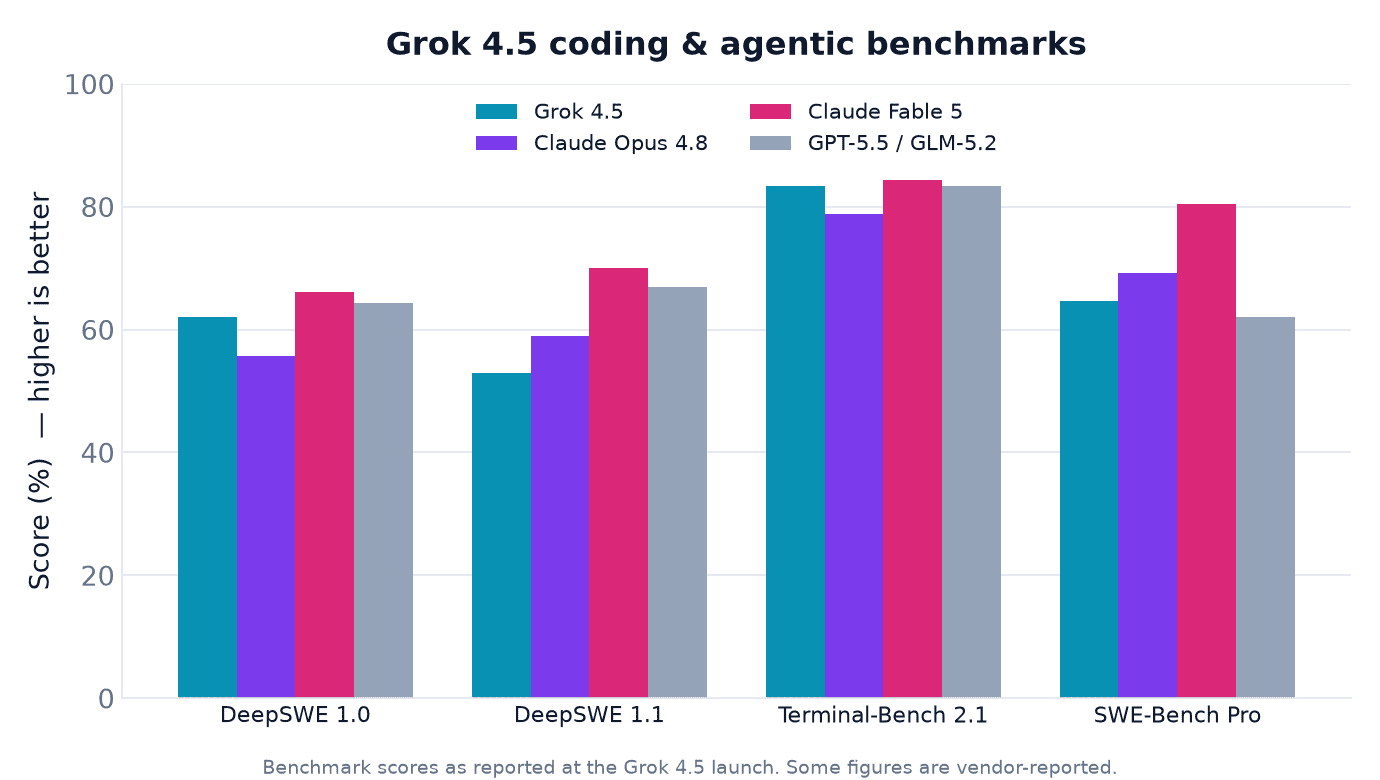
xAI published four headline benchmark comparisons at launch, and reading them honestly means looking at all four together rather than cherry-picking the ones where Grok 4.5 wins.
The four benchmarks xAI published
| Benchmark | Grok 4.5 | Opus 4.8 | Claude Fable 5 | GPT-5.5 / GLM-5.2 |
|---|---|---|---|---|
| DeepSWE 1.0 | 62.0% | 55.75% | 66.1% | GPT-5.5: 64.31% |
| DeepSWE 1.1 | 53% | 59% | 70% | GPT-5.5: 67%, GLM-5.2: 44% |
| Terminal-Bench 2.1 | 83.3% | 78.9% | 84.3% | GPT-5.5: 83.4% |
| SWE-Bench Pro | 64.7% | 69.2% | 80.4% | GLM-5.2: 62.1% |
How to read the numbers honestly
Grok 4.5 beats Opus 4.8 on 2 of the 4 published benchmarks — DeepSWE 1.0 and Terminal-Bench 2.1 — and loses on the other 2, trailing by 6 points on DeepSWE 1.1 and by 4.5 points on SWE-Bench Pro. Claude Fable 5 leads all four benchmarks outright. That makes “Opus-class” a fair description of Grok 4.5’s positioning, but “beats Opus” is not an accurate blanket claim.
Grok 4.5 Launched Today: What xAI’s Own Benchmarks Actually Show vs Opus 4.8.
beehiiv analysis, roo.beehiiv.com
It’s also worth flagging that all four figures are xAI’s own self-reported results, not independently verified at the time of launch. That doesn’t make them wrong, but it means third-party benchmark reruns are worth checking before making a purchasing decision based on these numbers alone.
Pricing and Token Efficiency
Price is where Grok 4.5’s pitch is most aggressive, and it’s arguably a bigger differentiator than any single benchmark score.
The price story
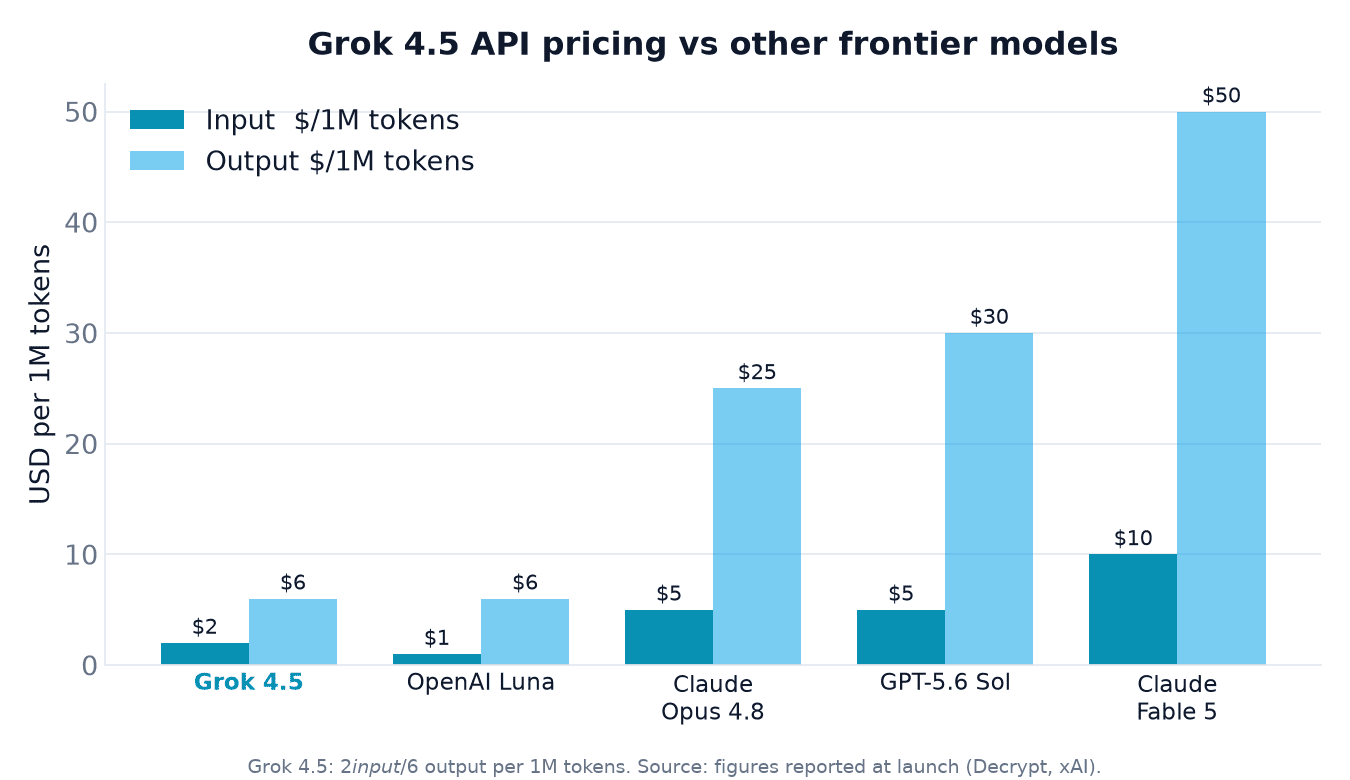
Grok 4.5 is priced at $2 per million input tokens and $6 per million output tokens. For comparison, Claude Opus 4.8 runs $5/$25, Claude Fable 5 runs $10/$50, and OpenAI’s GPT-5.6 Sol runs $5/$30 (OpenAI’s Luna model comes in lower at $1/$6). In practice, Grok 4.5 undercuts Opus-tier models by roughly half on both input and output pricing.
| Model | Input ($/M tokens) | Output ($/M tokens) |
|---|---|---|
| Grok 4.5 | $2 | $6 |
| Claude Opus 4.8 | $5 | $25 |
| GPT-5.6 Sol | $5 | $30 |
| Claude Fable 5 | $10 | $50 |
| OpenAI Luna | $1 | $6 |
Why efficiency is the real headline
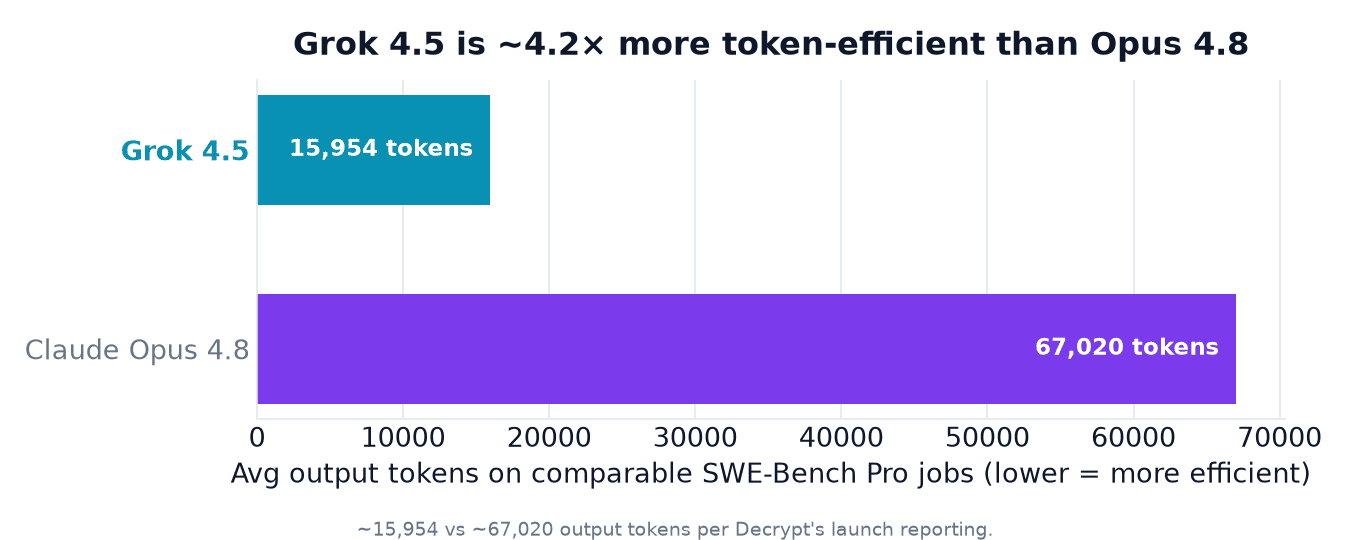
On SWE-Bench Pro, Grok 4.5 resolves tasks using an average of 15,954 output tokens, compared with 67,020 for Opus 4.8 (max) — a 4.2x gap in tokens consumed per task. xAI also describes the model as having “twice greater token efficiency” than leading competing models. For teams running high volumes of coding or agentic tasks, that token efficiency compounds directly on top of the already lower per-token price, which can make the real-world cost gap wider than the sticker price alone suggests.
What’s New vs Grok 4
The shift from Grok 4 to Grok 4.5 is less about a generic quality bump and more about a deliberate repositioning toward professional software work.
From V8-small to V9
Grok 4 ran on the V8-small foundation; Grok 4.5 moves to the V9-based model at roughly 3x that scale, landing at 1.5 trillion parameters. The headline change isn’t raw chat quality — it’s a cluster of practical upgrades:
- Coding and agentic focus over general chat performance
- Cursor-derived training signal from real developer sessions
- Meaningfully better token efficiency (roughly 2x leading models)
- New office-suite integration for Excel, PowerPoint and Word
Positioning shift
Grok 4.5’s marketing leans into “coding and agentic work” rather than the consumer-chatbot framing that defined earlier Grok releases. That reflects a deliberate go-to-market focus on professional developer and knowledge-work use cases.
Availability, Access and Is It Free?
Here’s how to actually get access to Grok 4.5 today, step by step:
- Open Grok Build — Grok 4.5 is already set as the default model, so no manual selection is needed.
- Check your Cursor plan — Grok 4.5 is available on all Cursor plans, not gated to a premium tier.
- For API access, use the xAI console with model id
grok-4.5. - If you’re in the EU, note that Grok 4.5 was not available at launch; regional access is expected by mid-July 2026.
- To try it without signing up for a paid plan, use a free third-party chat front-end such as Grok 4.5 free chat.
- For heavier or production usage, budget for the metered API pricing of $2 input / $6 output per million tokens once any free-access window ends.
Where you can use it
Grok 4.5 is available in Grok Build as the default model, inside Cursor on all plans, and through the xAI console and API under the model id grok-4.5. It is not yet available in the EU, with regional access expected by mid-July 2026.
Free access
xAI is offering free Grok 4.5 usage for a limited time inside both Grok Build and Cursor. It’s also reachable through free third-party chat wrappers such as Grok 4.5 free chat, which is useful for testing the model’s coding and agentic behavior before committing to metered API usage.
Limitations and Criticism
Grok 4.5 is a strong release, but it isn’t a frontier leader across the board, and a few gaps are worth knowing before relying on it for critical work:
- Not frontier-leading on published benchmarks — Claude Fable 5 tops all four of xAI’s own comparison tables, and Opus 4.8 wins 2 of 4
- Independent early testing has described its creative writing as underwhelming, while coding performance was rated closer to acceptable than exceptional outside the specific tasks xAI highlighted
- All benchmark numbers are self-reported by xAI, with no independent verification at launch
- No EU availability at launch, with regional access expected only by mid-July 2026
- xAI’s training practices have faced prior scrutiny
As Decrypt noted in its coverage of the launch, Musk himself framed the model as competing with — not clearly beating — Anthropic’s prior-generation Opus tier. Taken together, the picture is a genuinely competitive but not category-defining release.